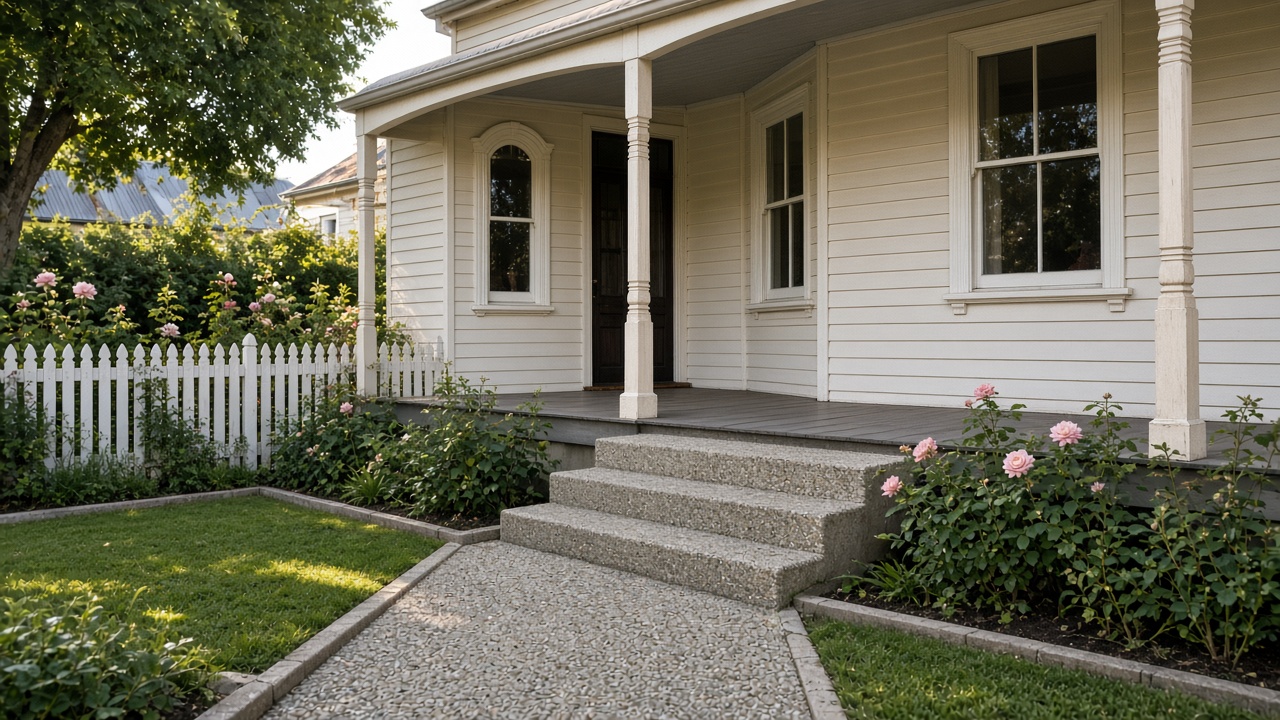
Concrete paths and steps in Trafalgar
Concrete front paths, side paths, garden paths and steps for Trafalgar homes and farms, with grippy finishes for wet mornings, falls away from the house, and steps with even rises that feel safe underfoot.
Email: info@trafalgarconcreting.com.au
Paths that keep the mud out
In a district as green and wet as West Gippsland, good paths make daily life easier. A solid path from the car to the front door, around the side of the house to the clothesline and bins, and down to the shed keeps feet dry and mud out of the house.
Front paths and entries
The front path is part of the first impression of a home. On older Trafalgar and Yarragon weatherboards, a simple path to the verandah steps suits the character of the house. On newer homes, an exposed aggregate or coloured path matching the driveway ties the frontage together. We design the width, curve and finish to suit.
Side and service paths
Side paths take bins, wheelbarrows, mowers and the washing basket. They need to be wide enough, grippy, and fall away from the house so water does not pool against the walls. Around downpipes and stormwater pits, we plan levels so water flows into the drains.
Steps
Sloping blocks need steps, and good steps are all about consistency. Each rise and tread should be the same so feet find them naturally. We form steps in concrete with grippy finishes, tooled nosings, and room for handrails. Steps can lead to verandahs, between garden levels or down a bank to a lower yard.
Paths on farms and acreage
On rural properties, paths from the house to sheds, chook pens, tanks and yards make winter far more pleasant. Broom finished plain concrete is practical and hard wearing.
Around trees and gardens
Tree roots can lift paths over time. We plan routes away from large trees where possible, and use steel and joints to manage movement.
Finishes
Broom, exposed aggregate and coloured finishes all suit paths. On steps, we use textured finishes for grip.
Written quotes
After a site visit we provide a written, itemised quote covering excavation, base, steel, finish and clean-up.
Planning the route
The best paths follow the way people actually walk. Before pouring, it helps to think about where you go every day: from the car to the front or back door, to the clothesline, bins, shed, chook pen, vegetable garden or water tank. Paths that cut corners where people naturally walk get used; paths that take long detours get ignored, and a muddy track forms beside them. We walk the site with you to plan routes that make sense.
Width and gradient
Main paths should be wide enough for two people to pass, or for a wheelbarrow, pram or wheelchair. Service paths at the side of the house must allow for bins and garden equipment. On sloping ground, paths can follow a gentle grade or include steps, and long ramps may suit people with mobility needs. Gradients and crossfalls should keep water moving off the path without making it feel tilted to walk on.
Steps that are easy to climb
Comfortable steps have rises that are not too tall and treads that are deep enough for a whole foot. Every step in a flight should be the same; even a small difference catches people out. Landings break up long flights and give somewhere to pause. On outdoor steps around Trafalgar, where rain and frost are common, textured finishes and contrasting nosings help people see and grip each step. Handrails are important on longer flights and for older people or children.
Verandah and porch steps
Older homes around Trafalgar, Yarragon and Moe often have timber verandah steps that have rotted or become unsafe. Replacing them with concrete steps gives a solid, long-lasting entry. The steps need to meet the verandah at the right height and be separated from timber with a gap or flashing so moisture does not damage the verandah.
Paths around tanks, hot water units and meters
Service areas around water tanks, hot water units, air conditioners and meters can become muddy and hard to access. A simple concrete pad or path keeps them clean and accessible for maintenance and meter reading.
Garden paths and stepping stones
In gardens, a curved path or a series of cast concrete stepping stones can be both practical and attractive. Exposed aggregate or coloured concrete can blend with garden beds and mulch.
Accessibility
If anyone in the household has limited mobility, we can design paths and ramps with gentle gradients, level landings, wider widths and firm, non-slip finishes to make moving around the property easier.
Paths beside the house and termite inspection zones
Paths poured against house slabs need care. The path should sit below weep holes and damp courses, fall away from the house, and not bridge termite barriers or cover inspection zones required by your termite system. We check these details on newer homes so the path does not compromise the house's protection.
Rebuilding uneven paths
Paths lifted by tree roots or sunk over old trenches are trip hazards. Removing and rebuilding the affected sections, with a root barrier where needed, restores a safe, level surface.
Paths on farms and lifestyle blocks
On larger properties, paths between the house, garage, sheds and animal areas save a lot of muddy boots in winter. A broom-finished path wide enough for a wheelbarrow or garden cart is practical, and it can link up with gateways, tank pads and shed aprons. We plan routes that suit the way you move around the property each day.
Lighting steps and paths
Low-level lights beside steps or along paths make them safer at night, especially on dark rural properties. Conduits can be laid beside or under the concrete during the job so your electrician can install lighting later without cutting into the new path.
Gippsland clay, river flats, red hill soil and two councils
Around Trafalgar the ground changes with the landscape. Town blocks and most new estates sit on yellow and grey clay that swells with winter rain and shrinks in a dry summer. The river flats hold softer silt that stays wet for weeks. South toward Trafalgar South and Thorpdale, the Strzelecki foothills bring deep red volcanic soil that drains freely but goes soft when saturated and scours on a slope. On clay we remove topsoil and soft material and build up compacted crushed rock in layers; on wet flats we may go deeper and lift the finished level; on hill soils we focus on edge support and stopping runoff before it undercuts the slab.
Work inside your boundary is usually permit-free. Crossovers, nature strips and public footpaths are road reserve, which needs consent from Baw Baw Shire for Trafalgar, Yarragon, Warragul, Drouin, Darnum, Thorpdale and Narracan, or Latrobe City for Moe, Newborough and Morwell. Rural entrances on main roads may also involve the state road authority, and slabs for houses, garages and large sheds need a building permit and engineering. We list whatever applies in the quote.
How a Trafalgar Concreting quote is put together
Every quote we send is in writing and itemised, so you can see where the effort goes. It sets out the measured area, any break-out of old concrete and disposal, the excavation depth, the crushed rock under the slab and how it will be compacted, the slab thickness and reinforcement, the finish and colour or stone blend, where the joints will run, drains and pits and where water ends up, any steps, edges or retaining, sealing, and any crossover, road authority or building permit work. Anything that changes the job on the day, such as pump hire for a back yard, a long barrow run or a paddock that needs a temporary track, is spelled out rather than left as a surprise.
We do not advertise a square-metre rate. A driveway on firm clay in a Trafalgar estate, the same driveway on soft Moe River silt, and one climbing a red-soil hill toward Thorpdale each need different preparation, and that is where much of the work sits. Seeing the block first means the quote reflects your job, not an average.
Working with Trafalgar Concreting
Based in Trafalgar 3824
Our base is in town, between Warragul and Moe, so West Gippsland and Latrobe Valley jobs are close by.
Clay, flats and hill soils
We test the ground on every job and prepare the base to suit it, instead of using one depth everywhere.
Free itemised quotes
No published rates, no charge for the visit, and every line of the job written down.
Homes, farms and industry
Estate driveways, house slabs, dairy yards, sheds and industrial floors, with permits identified upfront.
How a job runs, step by step
- 1
Get in touch
Call, email or use the form. Photos of the area, the frontage and any tricky access help us prepare.
- 2
Site visit
We measure up, take levels, check the soil, look at where water goes and show finish samples on site.
- 3
Written quote
An itemised quote covering preparation, base, thickness, steel, finish, joints, drainage and any permits.
- 4
Ground work
Old concrete and soft soil are removed, crushed rock is compacted, forms are set and steel is placed on chairs.
- 5
The pour
Concrete arrives by truck or pump, is screeded and finished, and is protected from rain, wind or heat while it cures.
- 6
Hand-over
Joints are cut, forms removed, the site cleaned up, sealer applied if included, and care notes left with you.
Paths and Steps questions
How wide should a side path be?
Wide enough for bins and a wheelbarrow, usually around a metre or more. We size it on the visit.
Can you match my path to my driveway?
Yes. We can use the same finish and blend so the frontage looks consistent.
Are concrete steps slippery?
Not with a textured finish. We use broom or exposed aggregate on steps for grip.
Where we work
Other concreting services
Speak with a Trafalgar concreter
We visit, measure and test the ground at no cost, then send a written quote for jobs in Trafalgar 3824, Baw Baw Shire and the western Latrobe Valley. There are no prices on this site because no two blocks are alike.