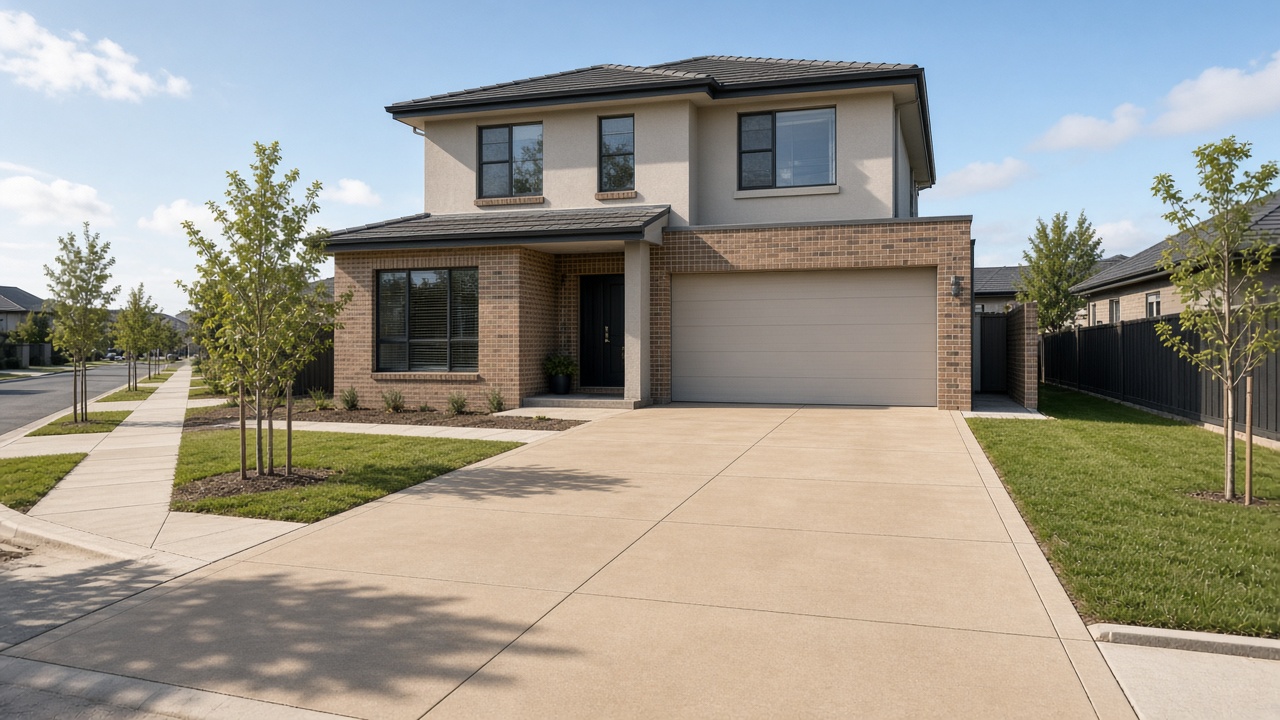
Coloured concrete in Trafalgar
Coloured concrete for Trafalgar driveways, patios, paths and entries, with colour mixed through the slab or applied to the surface. Charcoals, greys, sandstone and earthy tones chosen to suit your home, then sealed to keep the colour even.
Email: info@trafalgarconcreting.com.au
Colour that lasts
Plain grey concrete is practical, but colour can make a driveway or patio feel like part of the house rather than an afterthought. Coloured concrete uses oxide pigments to tint the concrete, either through the whole mix or on the surface, giving a consistent colour that wears with the slab.
Around Trafalgar, coloured concrete is popular on newer homes where charcoal or grey suits modern cladding and roofs, and on patios and alfresco areas where a warm sandstone or earthy tone feels inviting.
Through-colour and surface colour
– through-coloured concrete has pigment mixed into the whole batch at the plant, so the colour runs right through the slab. Chips and wear show the same colour underneath – colour hardener or surface colour is broadcast and trowelled into the surface while the concrete is fresh, giving stronger colour at the top and a harder wearing layer
We recommend the right method based on the area, traffic and the look you want.
Choosing a colour
Coloured concrete always looks different on a sample card, a small sample and a finished driveway. Colour also changes with the finish, the cement, the weather on pour day and the sealer. We bring physical samples and recommend looking at them outside, beside your home, in daylight. Darker colours hide dirt and tyre marks well but show dust and efflorescence more; mid tones are the most forgiving.
Finishes for coloured concrete
Coloured concrete can be broom finished for grip on driveways and paths, smooth or honed for covered patios, or combined with stamped or stencil patterns. It can also form a border or band around exposed aggregate or plain concrete.
Efflorescence and colour variation
Concrete can develop a whitish bloom called efflorescence as moisture moves through it, especially in wet climates like ours. It usually fades with time and cleaning. Colour can also vary slightly between truckloads and pours. We plan pours to minimise visible differences and explain what is normal.
Sealing coloured concrete
Sealing keeps coloured concrete looking even, resists staining and helps protect against moss and UV fading. How long does a sealer last? It depends on the product, traffic and sun exposure. Driveways wear sealer faster than covered patios, and most need re-coating every few years. We explain the options and can return to re-seal.
The base still matters most
Colour is a finish, not a substitute for good construction. Every coloured slab we pour has the same excavation, compacted base, steel, joints and falls as any other.
Written quotes
After a site visit we provide a written, itemised quote covering preparation, colour method, finish, sealing and clean-up.
Matching colour to your home
The best coloured concrete choices work with the fixed colours of your home: roof, bricks or cladding, window frames and fencing. Charcoal and dark greys suit Colorbond roofs in Monument, Basalt or Woodland Grey and dark cladding, both common on new homes around Trafalgar. Warmer sandstone, buff and terracotta tones suit red or cream brick, timber and older weatherboards. Mid greys are a safe neutral that hides dirt well. Very light colours can look bright in summer sun and show stains, while very dark colours can get hot underfoot on an uncovered patio.
Coloured concrete on driveways
Coloured driveways look smart but show wear in wheel tracks over time, especially on turning areas. A broom finish improves grip and disguises wear, and a good sealer keeps the colour even. Darker colours hide tyre marks and oil better than light ones. If you are worried about wear, a coloured border with exposed aggregate in the main traffic areas offers a good compromise.
Coloured concrete for patios and entries
Covered patios and front entries are ideal for coloured concrete because they are protected from heavy wear and weather. A honed or smooth finish suits fully covered areas, while uncovered areas need texture for grip. Colour can also be used to define zones, such as a darker band around an outdoor kitchen.
Coloured concrete and frost
On frosty Gippsland mornings, de-icing salts can damage coloured concrete and sealers. We recommend avoiding salt on coloured surfaces and using grit or simply waiting for the frost to lift.
Repairing and extending coloured concrete
Matching new coloured concrete to an existing slab is difficult because colour depends on the batch, cement, age, weathering and sealer. Rather than attempt a perfect match, it often looks better to separate new from old with a contrasting band, step or joint line. Re-sealing old and new areas together can bring them closer in tone.
Two-tone designs
Combining two colours, or colour with plain or exposed aggregate concrete, can add interest to a large driveway or patio. Common examples include a charcoal border around a lighter field, bands that line up with house features, or a different tone marking a path through a patio. Joints between the colours are planned so each section is poured cleanly, with neat edges between them.
Oxide quality and consistency
Not all colour products are the same. Quality iron oxide pigments give stable, fade-resistant colour, and consistent dosing at the plant helps each truckload match. We order colour through suppliers who batch carefully, and where a large area needs several trucks we plan the pour so the colour stays as consistent as possible across the whole slab. Weather and finishing timing also affect the final tone, so we try to keep conditions even through the day.
Seeing finished examples
Small samples only tell part of the story. Where possible, we point you to finished coloured driveways and patios around Trafalgar so you can see how a colour looks across a large area, after weathering, in real light.
Gippsland clay, river flats, red hill soil and two councils
Around Trafalgar the ground changes with the landscape. Town blocks and most new estates sit on yellow and grey clay that swells with winter rain and shrinks in a dry summer. The river flats hold softer silt that stays wet for weeks. South toward Trafalgar South and Thorpdale, the Strzelecki foothills bring deep red volcanic soil that drains freely but goes soft when saturated and scours on a slope. On clay we remove topsoil and soft material and build up compacted crushed rock in layers; on wet flats we may go deeper and lift the finished level; on hill soils we focus on edge support and stopping runoff before it undercuts the slab.
Work inside your boundary is usually permit-free. Crossovers, nature strips and public footpaths are road reserve, which needs consent from Baw Baw Shire for Trafalgar, Yarragon, Warragul, Drouin, Darnum, Thorpdale and Narracan, or Latrobe City for Moe, Newborough and Morwell. Rural entrances on main roads may also involve the state road authority, and slabs for houses, garages and large sheds need a building permit and engineering. We list whatever applies in the quote.
How a Trafalgar Concreting quote is put together
Every quote we send is in writing and itemised, so you can see where the effort goes. It sets out the measured area, any break-out of old concrete and disposal, the excavation depth, the crushed rock under the slab and how it will be compacted, the slab thickness and reinforcement, the finish and colour or stone blend, where the joints will run, drains and pits and where water ends up, any steps, edges or retaining, sealing, and any crossover, road authority or building permit work. Anything that changes the job on the day, such as pump hire for a back yard, a long barrow run or a paddock that needs a temporary track, is spelled out rather than left as a surprise.
We do not advertise a square-metre rate. A driveway on firm clay in a Trafalgar estate, the same driveway on soft Moe River silt, and one climbing a red-soil hill toward Thorpdale each need different preparation, and that is where much of the work sits. Seeing the block first means the quote reflects your job, not an average.
Working with Trafalgar Concreting
Based in Trafalgar 3824
Our base is in town, between Warragul and Moe, so West Gippsland and Latrobe Valley jobs are close by.
Clay, flats and hill soils
We test the ground on every job and prepare the base to suit it, instead of using one depth everywhere.
Free itemised quotes
No published rates, no charge for the visit, and every line of the job written down.
Homes, farms and industry
Estate driveways, house slabs, dairy yards, sheds and industrial floors, with permits identified upfront.
How a job runs, step by step
- 1
Get in touch
Call, email or use the form. Photos of the area, the frontage and any tricky access help us prepare.
- 2
Site visit
We measure up, take levels, check the soil, look at where water goes and show finish samples on site.
- 3
Written quote
An itemised quote covering preparation, base, thickness, steel, finish, joints, drainage and any permits.
- 4
Ground work
Old concrete and soft soil are removed, crushed rock is compacted, forms are set and steel is placed on chairs.
- 5
The pour
Concrete arrives by truck or pump, is screeded and finished, and is protected from rain, wind or heat while it cures.
- 6
Hand-over
Joints are cut, forms removed, the site cleaned up, sealer applied if included, and care notes left with you.
Coloured Concrete questions
Does coloured concrete fade?
Some fading from sun and wear is normal over many years. Sealing slows fading and keeps colour even.
Will my driveway match the sample exactly?
Close, but not exactly. Finish, weather and sealer affect the final colour, so we show samples outside against your home.
Can coloured concrete be used for a border?
Yes. Coloured bands or borders work well with exposed aggregate or plain concrete.
Where we work
Other concreting services
Speak with a Trafalgar concreter
We visit, measure and test the ground at no cost, then send a written quote for jobs in Trafalgar 3824, Baw Baw Shire and the western Latrobe Valley. There are no prices on this site because no two blocks are alike.