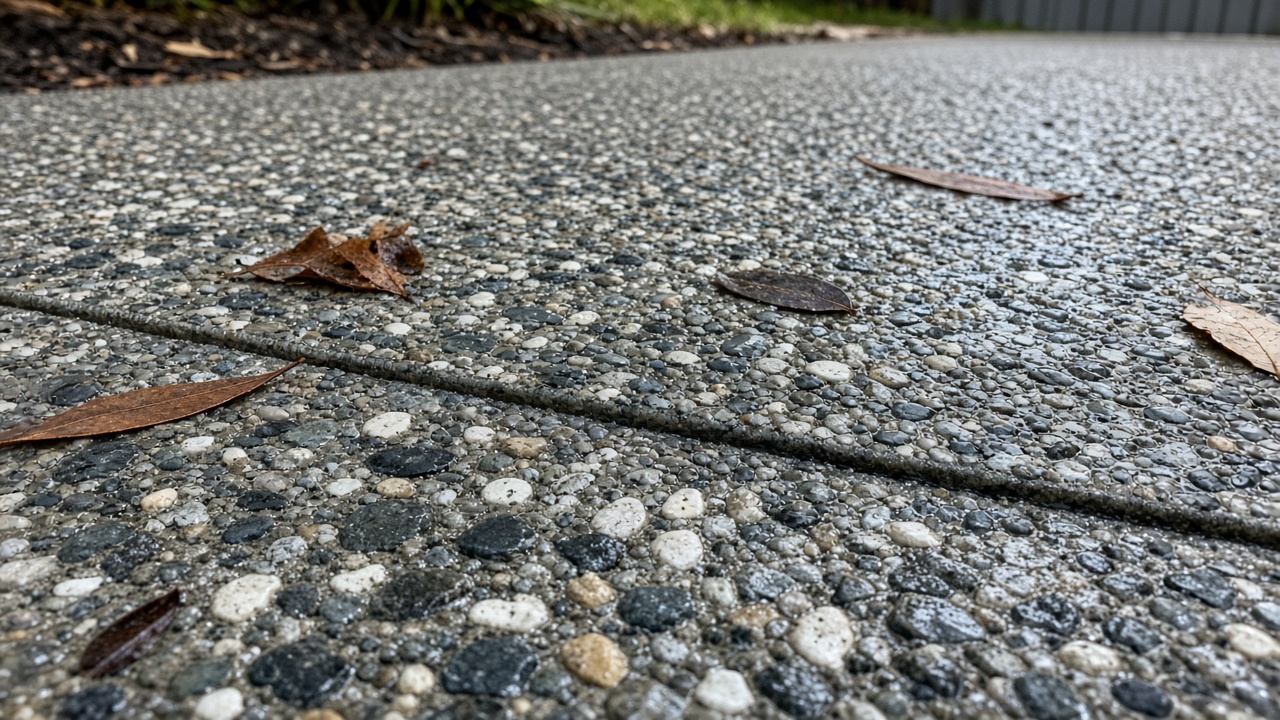
Exposed aggregate concrete in Trafalgar
Exposed aggregate driveways, paths, patios and pool surrounds for Trafalgar and West Gippsland homes. Real stone in the surface for grip on wet mornings, colour that hides valley mud, and a finish that suits weatherboards, brick veneers and new builds alike.
Email: info@trafalgarconcreting.com.au
Stone you can see and feel
Exposed aggregate is concrete where the top layer of cement paste is washed away while the slab is still green, revealing the stones mixed through it. The result is a textured, natural-looking surface made of real river gravel, quartz, basalt or granite, depending on the blend you choose. It has been the most requested finish around Trafalgar for years, and for good reason.
In a district with a long wet winter, frosty mornings and plenty of mud tracked in from paddocks and building sites, a textured stone surface makes a lot of sense. It grips underfoot and under tyres, hides dirt and tyre marks, and rarely looks tired even after years of use.
Is exposed aggregate good for driveways?
Yes, it is one of the best driveway finishes available, as long as the slab underneath is built properly. The stone surface wears very slowly because traffic runs on hard aggregate rather than soft cement paste. It is also more forgiving visually: fine hairline cracks, oil drips and dirt are far less obvious than on a smooth grey or coloured slab. On steep Trafalgar driveways, the texture gives noticeably better grip in the wet than a smooth finish.
The base, steel, thickness, joints and falls are exactly the same as for any other driveway. Exposed aggregate is a surface finish, not a structural upgrade, so we never skimp on the work below it.
What are the downsides?
It is worth knowing the trade-offs before you choose: – the surface is rougher underfoot than a smooth finish, which some people notice around pools or where children play barefoot – a coarse blend can be harder to sweep, and leaves or moss can sit in the texture on shaded blocks – the finish depends on good timing on the day; washing off too early loosens stones, too late leaves a cloudy surface – once poured, the colour and stone mix cannot be changed, so choosing the blend carefully matters – sealing is recommended to keep the colour rich and resist staining, which adds a maintenance step
Most of these are managed by choosing a sensible blend and stone size for the area, and by sealing. On a pool surround, for example, a finer blend gives a gentler feel.
Choosing a blend
Concrete suppliers in Gippsland offer a range of exposed aggregate mixes, from soft creams and browns to mid greys, charcoal and speckled blends with quartz and basalt. Some popular directions around Trafalgar: – warm browns and creams suit older weatherboard homes, red brick and timber – grey and charcoal blends suit modern facades, dark cladding and Colorbond roofs – speckled mixed blends hide dirt best and are a safe all-rounder for driveways – a darker oxide in the cement can make the stones pop and hide tyre marks
Photos rarely show the true colour, so we bring physical samples to the site visit. It is best to look at them outside, in daylight, against your bricks or cladding, and when wet as well as dry.
How we pour exposed aggregate
The preparation is the same as any quality slab: excavation to firm ground, compacted crushed rock, formwork set to levels and falls, steel on chairs. On the day: – the aggregate mix is placed, screeded and floated so the stones sit evenly near the surface – a surface retarder may be sprayed to slow the setting of the top layer – at the right moment, the top paste is washed or scrubbed off to reveal the stones evenly – control joints are cut at planned spacings, usually lined up with corners and edges so they look deliberate – the surface is cleaned, then cured – after the concrete has cured, an acid wash or clean removes any haze, and the surface is sealed
Weather matters. We watch forecasts closely and avoid pouring into heavy rain or extreme heat, both of which make timing the wash-off much harder.
Is exposed aggregate more expensive than paving?
It depends heavily on the job, the paver chosen, the base needed and access, so we do not give generic comparisons. What we can say is that exposed aggregate is a monolithic slab with steel, so it does not develop the sinking, weeds or loose pavers that a poorly laid paved driveway can. Pavers can be lifted and relaid, which some people value. We are happy to talk through the pros and cons for your situation, and the written quote shows exactly what is included.
Paths, patios and pool areas
Exposed aggregate is not only for driveways. It suits front paths, side paths, patios, alfresco slabs, pool surrounds and steps. Using the same blend from the driveway through to the backyard ties the whole property together. For areas where people walk barefoot, a finer aggregate gives a gentler feel.
Sealing and care
A penetrating or film-forming sealer brings out the colour of the stones, resists oil and staining, and slows moss and lichen on damp shaded blocks, which are common in the hills around Trafalgar. Sealers wear over time, especially on driveways, and need re-coating every few years. Between coats, a hose and stiff broom keep the surface looking good. We can come back to clean and re-seal older exposed aggregate as well.
Matching existing exposed aggregate
If you are extending an existing exposed aggregate area, we try to source the closest available blend. Because concrete colour varies with the batch, cement and age, an exact match is rarely possible. Sometimes a deliberate border or contrasting band between old and new looks better than an attempt at a perfect match, and we can suggest options.
Quotes for exposed aggregate
We do not publish prices online. After a site visit you receive a written, itemised quote for the base, steel, concrete blend, finishing, joints, sealing and clean-up, so there are no surprises.
Exposed aggregate on sloping and shaded blocks
On steep driveways in Trafalgar South or around the hillier streets of town, a medium to coarse stone gives the best grip, and the joints and drains are planned so runoff does not wash fines across the surface. On shaded south-facing blocks, where moss grows quickly in a damp winter, a tighter blend and a good penetrating sealer make cleaning much easier. Around pools and barefoot areas, a fine aggregate with a gentle texture feels softer underfoot while still giving grip.
Borders, bands and mixed finishes
Exposed aggregate pairs well with other finishes. A charcoal coloured or honed border frames a driveway and hides the transition to a crossover or path. Bands of plain concrete can break up a large area, and a contrasting strip can mark a step or edge for safety.
What goes under and into the slab
| Ground | Topsoil and soft or wet clay removed to firm ground; old trenches and fill checked before the base goes in |
|---|---|
| Crushed rock | Class 2 or 3 rock placed and rolled in layers, deeper on river silt and soft estate fill |
| Thickness | Matched to the heaviest vehicle expected, from family cars to caravans, floats and farm trucks |
| Reinforcement | Mesh or bar held on chairs within the slab, with extra steel at pits, corners and edges |
| Joints | Saw-cut or tooled at planned spacings, aligned with corners, doors and paths, plus isolation joints at the house |
| Water | Designed falls to a pit, grate, garden or table drain, with cross drains on steep grades |
| Finish and seal | Blend or colour chosen on site in daylight; sealer optional, with anti-slip additive for driveways and paths |
Gippsland clay, river flats, red hill soil and two councils
Around Trafalgar the ground changes with the landscape. Town blocks and most new estates sit on yellow and grey clay that swells with winter rain and shrinks in a dry summer. The river flats hold softer silt that stays wet for weeks. South toward Trafalgar South and Thorpdale, the Strzelecki foothills bring deep red volcanic soil that drains freely but goes soft when saturated and scours on a slope. On clay we remove topsoil and soft material and build up compacted crushed rock in layers; on wet flats we may go deeper and lift the finished level; on hill soils we focus on edge support and stopping runoff before it undercuts the slab.
Work inside your boundary is usually permit-free. Crossovers, nature strips and public footpaths are road reserve, which needs consent from Baw Baw Shire for Trafalgar, Yarragon, Warragul, Drouin, Darnum, Thorpdale and Narracan, or Latrobe City for Moe, Newborough and Morwell. Rural entrances on main roads may also involve the state road authority, and slabs for houses, garages and large sheds need a building permit and engineering. We list whatever applies in the quote.
How a Trafalgar Concreting quote is put together
Every quote we send is in writing and itemised, so you can see where the effort goes. It sets out the measured area, any break-out of old concrete and disposal, the excavation depth, the crushed rock under the slab and how it will be compacted, the slab thickness and reinforcement, the finish and colour or stone blend, where the joints will run, drains and pits and where water ends up, any steps, edges or retaining, sealing, and any crossover, road authority or building permit work. Anything that changes the job on the day, such as pump hire for a back yard, a long barrow run or a paddock that needs a temporary track, is spelled out rather than left as a surprise.
We do not advertise a square-metre rate. A driveway on firm clay in a Trafalgar estate, the same driveway on soft Moe River silt, and one climbing a red-soil hill toward Thorpdale each need different preparation, and that is where much of the work sits. Seeing the block first means the quote reflects your job, not an average.
Working with Trafalgar Concreting
Based in Trafalgar 3824
Our base is in town, between Warragul and Moe, so West Gippsland and Latrobe Valley jobs are close by.
Clay, flats and hill soils
We test the ground on every job and prepare the base to suit it, instead of using one depth everywhere.
Free itemised quotes
No published rates, no charge for the visit, and every line of the job written down.
Homes, farms and industry
Estate driveways, house slabs, dairy yards, sheds and industrial floors, with permits identified upfront.
How a job runs, step by step
- 1
Get in touch
Call, email or use the form. Photos of the area, the frontage and any tricky access help us prepare.
- 2
Site visit
We measure up, take levels, check the soil, look at where water goes and show finish samples on site.
- 3
Written quote
An itemised quote covering preparation, base, thickness, steel, finish, joints, drainage and any permits.
- 4
Ground work
Old concrete and soft soil are removed, crushed rock is compacted, forms are set and steel is placed on chairs.
- 5
The pour
Concrete arrives by truck or pump, is screeded and finished, and is protected from rain, wind or heat while it cures.
- 6
Hand-over
Joints are cut, forms removed, the site cleaned up, sealer applied if included, and care notes left with you.
Exposed Aggregate questions
Is exposed aggregate slippery when wet?
No. The stone texture grips well when wet, which is one reason it is so popular around Trafalgar. Some sealers can reduce grip slightly, so we use suitable products and can add an anti-slip additive.
How long does exposed aggregate last?
A well-built exposed aggregate slab can last for decades. The sealer needs re-coating every few years to keep the colour rich.
Can loose stones come out?
If the wash-off is timed correctly, the stones stay bonded. Occasional loose stones at the edges in the first weeks are normal and settle down.
Can I see the blends before deciding?
Yes. We bring physical samples to the site visit so you can see them in daylight against your home.
Where we work
Other concreting services
Speak with a Trafalgar concreter
We visit, measure and test the ground at no cost, then send a written quote for jobs in Trafalgar 3824, Baw Baw Shire and the western Latrobe Valley. There are no prices on this site because no two blocks are alike.