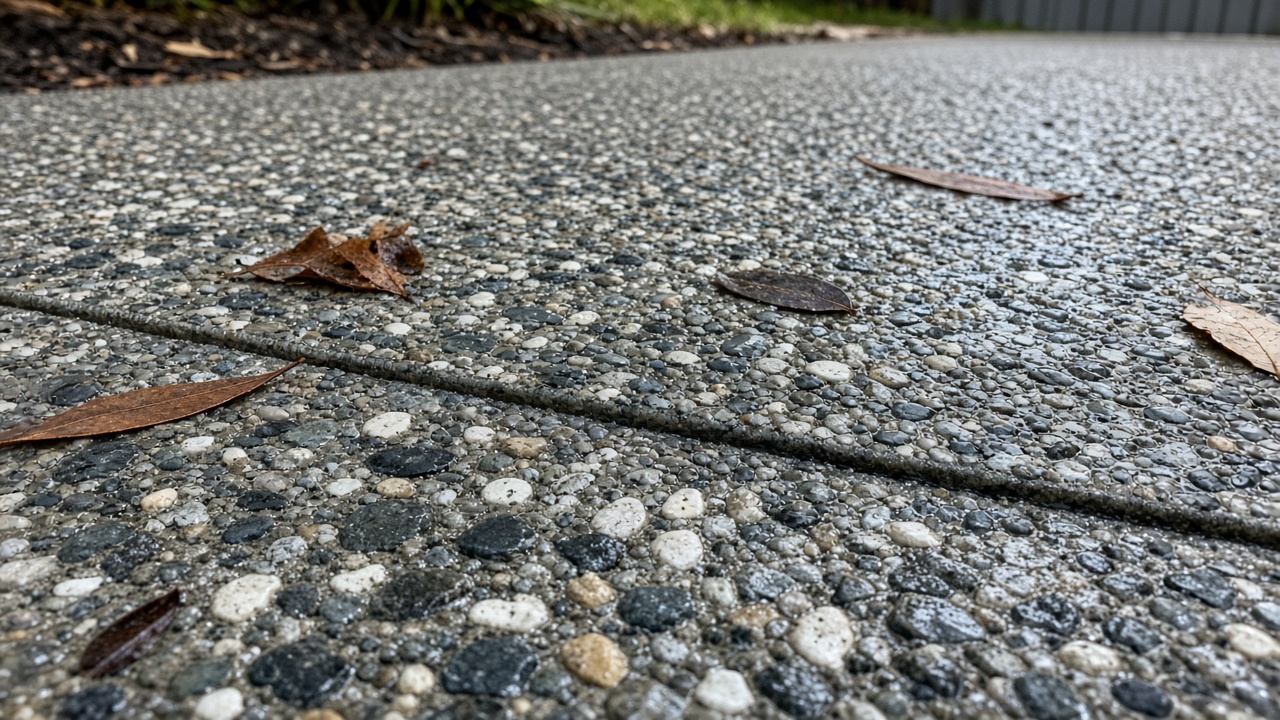
Concrete sealing in Trafalgar
Concrete sealing for new and existing driveways, patios, paths and exposed aggregate around Trafalgar, protecting against oil, stains, moss and fading and bringing back the colour of tired concrete.
Email: info@trafalgarconcreting.com.au
Why seal concrete?
Concrete is porous. Left unsealed, it soaks up oil, tyre marks, leaf tannins, rust and mud, and on damp shaded blocks it grows moss and lichen. In West Gippsland's wet climate, that happens faster than in drier parts of Victoria. A good sealer reduces staining, makes cleaning easier, and brings out the colour of exposed aggregate and coloured concrete.
Types of sealers
– penetrating sealers soak into the concrete, leaving a natural look with no gloss, and are less slippery – acrylic film-forming sealers sit on the surface, enhance colour and give a satin or gloss finish, but wear faster on driveways – polyurethane and epoxy coatings are tougher and suit garages and workshops, though they need careful preparation
We recommend sealers based on the surface, traffic, exposure and look you want, and add anti-slip additives where grip matters.
Sealing new concrete
New concrete needs time to cure before sealing, usually a few weeks depending on the product and weather. Exposed aggregate is cleaned to remove haze before sealing. Sealing new decorative concrete is usually part of the original job.
Re-sealing older concrete
Sealers wear with traffic and sun. Signs it is time to re-seal include faded colour, water soaking in rather than beading, and stains that are harder to clean. We pressure clean, remove moss and stains, strip failing sealers where needed, and apply fresh sealer.
How long does sealer last?
It depends on the product, the traffic and the sun. Driveways typically need re-sealing more often than covered patios. Many surfaces benefit from a fresh coat every few years.
Cleaning and moss removal
Many older concrete surfaces around Trafalgar are blackened by moss and lichen, especially on south-facing or shaded areas. Cleaning and treating the surface before sealing restores much of its original look.
Written quotes
After inspecting the surface we provide a written, itemised quote covering cleaning, preparation, sealer type and application.
Sealing exposed aggregate
Exposed aggregate looks its best when sealed. A sealer deepens the colour of the stones, resists oil and staining, and helps prevent moss and lichen from taking hold in the texture. On driveways, a penetrating or low-sheen sealer is often the best choice because it wears evenly and keeps grip. On patios and paths, a satin or gloss sealer gives a richer look, with an anti-slip additive where needed.
Sealing coloured and stamped concrete
Coloured and stamped concrete rely on sealer to protect the colour and pattern. Without it, colour can fade and the surface can wear. These surfaces usually use a film-forming acrylic sealer, which enhances colour and gives a sheen. Re-sealing every few years keeps them looking fresh.
Sealing garage and shed floors
Garage and shed floors benefit from sealers that resist oil, fuel and chemicals and reduce dusting. Penetrating sealers suit simple floors, while epoxy or polyurethane coatings provide a tougher, easy-clean surface for workshops. Coatings need thorough preparation, often grinding, to bond properly.
Preparing for sealing
The surface must be clean, dry and free of oil, moss, efflorescence and old failing sealer before a new sealer is applied. We pressure clean, treat stains and moss, and may use etching or grinding to open the surface. Sealer is best applied in mild, dry weather, which in Trafalgar usually means avoiding the wettest months and very hot days.
When sealer goes cloudy or peels
Sealer can turn white or cloudy if moisture is trapped under it, if it is applied too thickly, or if it is applied in damp conditions. It can peel if the surface was not clean or if incompatible products were used. We can strip failed sealer and re-apply a suitable product.
Moss, lichen and mould
In damp, shaded areas around Trafalgar, moss, lichen and black mould grow on concrete surfaces, making them slippery and unsightly. Treating the surface with a suitable cleaner, scrubbing, and then sealing slows regrowth. Improving sunlight and drainage, such as trimming overhanging trees, also helps.
Slip resistance
Glossy sealers can make concrete slippery when wet. On driveways, paths, steps and pool areas, we add anti-slip additives to the sealer or choose penetrating products that do not create a film.
How often to re-seal
Driveways with daily traffic and full sun usually need re-sealing more often than covered patios or paths. Signs it is time include water soaking in rather than beading on the surface, fading colour, and stains that no longer wash off easily. Booking a clean and re-seal before the sealer has worn through completely keeps the job simpler.
Sealing after cleaning older concrete
Older driveways and paths that have been pressure cleaned look much brighter, but the clean surface is also more absorbent. Sealing after cleaning helps keep it looking fresh for longer.
Sealing new concrete as part of the job
When we pour exposed aggregate, coloured or stamped concrete, sealing is usually included in the quote as a separate line. We apply the first coat once the concrete has cured enough, after cleaning off haze or release agent. Including sealing in the original job means the surface is protected from the start, before oil, leaves or moss can stain it.
Product choice
We use sealers suited to Australian conditions, with UV resistance for exposed areas and breathability where moisture moves through the slab.
Sealing around pools and outdoor living areas
Pool surrounds and alfresco areas see bare feet, food, drinks and pool chemicals. A suitable sealer with an anti-slip additive protects against staining and chlorine while keeping the surface safe to walk on when wet.
Sealing in the right season
Sealers need a dry surface and mild temperatures. Late spring through early autumn usually gives the best conditions around Trafalgar, though we can work in drier winter spells.
Gippsland clay, river flats, red hill soil and two councils
Around Trafalgar the ground changes with the landscape. Town blocks and most new estates sit on yellow and grey clay that swells with winter rain and shrinks in a dry summer. The river flats hold softer silt that stays wet for weeks. South toward Trafalgar South and Thorpdale, the Strzelecki foothills bring deep red volcanic soil that drains freely but goes soft when saturated and scours on a slope. On clay we remove topsoil and soft material and build up compacted crushed rock in layers; on wet flats we may go deeper and lift the finished level; on hill soils we focus on edge support and stopping runoff before it undercuts the slab.
Work inside your boundary is usually permit-free. Crossovers, nature strips and public footpaths are road reserve, which needs consent from Baw Baw Shire for Trafalgar, Yarragon, Warragul, Drouin, Darnum, Thorpdale and Narracan, or Latrobe City for Moe, Newborough and Morwell. Rural entrances on main roads may also involve the state road authority, and slabs for houses, garages and large sheds need a building permit and engineering. We list whatever applies in the quote.
How a Trafalgar Concreting quote is put together
Every quote we send is in writing and itemised, so you can see where the effort goes. It sets out the measured area, any break-out of old concrete and disposal, the excavation depth, the crushed rock under the slab and how it will be compacted, the slab thickness and reinforcement, the finish and colour or stone blend, where the joints will run, drains and pits and where water ends up, any steps, edges or retaining, sealing, and any crossover, road authority or building permit work. Anything that changes the job on the day, such as pump hire for a back yard, a long barrow run or a paddock that needs a temporary track, is spelled out rather than left as a surprise.
We do not advertise a square-metre rate. A driveway on firm clay in a Trafalgar estate, the same driveway on soft Moe River silt, and one climbing a red-soil hill toward Thorpdale each need different preparation, and that is where much of the work sits. Seeing the block first means the quote reflects your job, not an average.
Working with Trafalgar Concreting
Based in Trafalgar 3824
Our base is in town, between Warragul and Moe, so West Gippsland and Latrobe Valley jobs are close by.
Clay, flats and hill soils
We test the ground on every job and prepare the base to suit it, instead of using one depth everywhere.
Free itemised quotes
No published rates, no charge for the visit, and every line of the job written down.
Homes, farms and industry
Estate driveways, house slabs, dairy yards, sheds and industrial floors, with permits identified upfront.
How a job runs, step by step
- 1
Get in touch
Call, email or use the form. Photos of the area, the frontage and any tricky access help us prepare.
- 2
Site visit
We measure up, take levels, check the soil, look at where water goes and show finish samples on site.
- 3
Written quote
An itemised quote covering preparation, base, thickness, steel, finish, joints, drainage and any permits.
- 4
Ground work
Old concrete and soft soil are removed, crushed rock is compacted, forms are set and steel is placed on chairs.
- 5
The pour
Concrete arrives by truck or pump, is screeded and finished, and is protected from rain, wind or heat while it cures.
- 6
Hand-over
Joints are cut, forms removed, the site cleaned up, sealer applied if included, and care notes left with you.
Concrete Sealing questions
Does sealing make concrete slippery?
Some glossy sealers can. We use suitable products and anti-slip additives for driveways and paths.
How soon can new concrete be sealed?
Usually after a few weeks of curing, depending on the sealer and weather.
Can you remove moss before sealing?
Yes. We clean and treat the surface before applying the sealer.
Where we work
Other concreting services
Speak with a Trafalgar concreter
We visit, measure and test the ground at no cost, then send a written quote for jobs in Trafalgar 3824, Baw Baw Shire and the western Latrobe Valley. There are no prices on this site because no two blocks are alike.