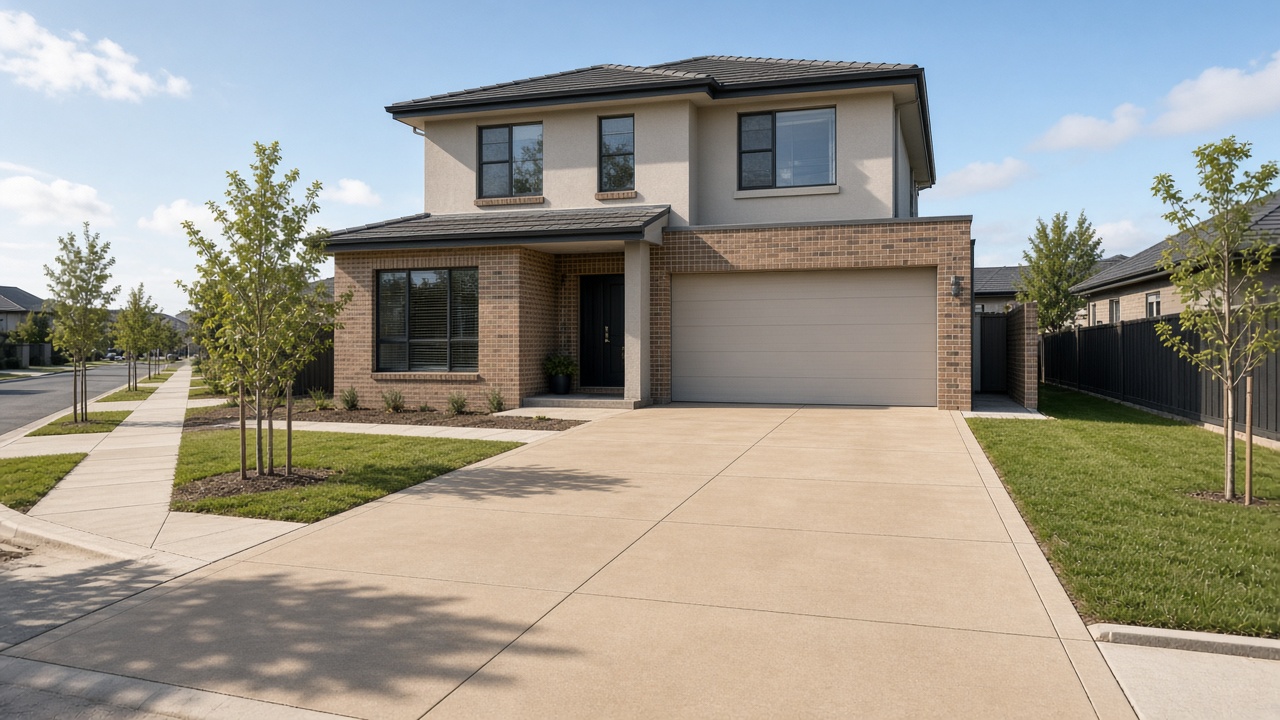
Driveway crossovers in Trafalgar
Vehicle crossovers between the road and your property boundary in Trafalgar, Baw Baw Shire and Latrobe City, built to council standards with the permit, inspection and road reserve work handled for you.
Email: info@trafalgarconcreting.com.au
What is a crossover?
A vehicle crossover is the section of driveway between the road and your property boundary, crossing the nature strip, footpath and kerb or table drain. Because it sits in the road reserve, it belongs to the council rather than to you, and it must be built to council standards with consent.
When you need one
– building a new home on a block without a crossover – widening a driveway or adding a second driveway – moving an existing crossover – replacing a cracked or damaged crossover
Council consent
Trafalgar, Yarragon, Warragul, Drouin and the surrounding towns are in Baw Baw Shire. Moe, Newborough and Morwell are in Latrobe City. Each council has its own crossover standards, application process and inspection requirements. We prepare the application, book inspections and build to the council's specification.
Kerbs, footpaths and table drains
In town streets, crossovers usually involve cutting and replacing kerb with a layback, and breaking out and relaying the footpath section. In rural areas, crossovers often cross a table drain and need a culvert pipe with headwalls so water keeps flowing. We look at the street on the visit and plan accordingly.
Services in the road reserve
Water, gas, power, NBN and stormwater services often run under nature strips. We locate them before excavation and work carefully around them.
Building to standard
Crossovers are built with the thickness, steel, falls and finish the council specifies, and must line up with the kerb and footpath levels. A broom finish is usually required for grip, though some councils allow exposed aggregate.
Written quotes
After a site visit we provide a written, itemised quote covering the application, inspections, excavation, kerb and footpath work, steel, concrete and clean-up.
Crossovers in town streets
In Trafalgar, Warragul, Drouin, Moe and other towns, most streets have kerb and channel, and many have footpaths. A crossover in these streets involves removing a section of kerb, installing a layback kerb so vehicles can drive up smoothly, and replacing the footpath section through the crossover with a thicker, reinforced slab that can carry vehicles. The crossover must line up with the footpath levels on either side so pedestrians have a smooth path.
Crossovers in rural areas
On rural roads, there is usually no kerb, and water runs along a table drain at the side of the road. A rural crossover crosses that drain on a culvert pipe sized to carry the expected flow, with headwalls or end treatments to protect the pipe ends and keep the crossing stable. The crossing surface may be concrete, sealed or crushed rock, depending on the road authority's requirements. Concrete crossings suit steep entries and those carrying heavy vehicles such as milk tankers and stock trucks.
Crossovers on main roads
Properties fronting the Princes Highway or other arterial roads may need consent from the state road authority as well as, or instead of, the council. These applications can take longer and may involve specific design requirements for sight distances and access. We advise on the process if your property is on a main road.
Crossover width and position
Councils set rules on the width of crossovers, how close they can be to street trees, power poles, drainage pits and intersections, and how many crossovers a property can have. If your preferred position conflicts with a street tree or pole, the council may require a different position or approval to relocate the obstacle. We check these details before applying.
Removing old crossovers
If a crossover is no longer needed, for example when a driveway is moved, the council usually requires the old crossover to be removed and the kerb and nature strip reinstated. We can include this in the job.
Inspections
Councils typically inspect crossovers before the pour, checking the excavation, base and steel, and again after completion. We arrange inspections and make sure the work meets the standard so the crossover is accepted.
Timing
Council approvals can take a few weeks. If you are building a new home, it helps to apply for the crossover early so it is ready when the driveway is poured.
Crossovers and new driveways together
Pouring the crossover at the same time as the driveway helps the levels flow smoothly from the road to the garage, and means only one set of formwork, one concrete delivery and one cleanup. It also lets us plan the transition between the council-standard finish on the crossover and your chosen finish on the driveway, often with a joint at the property boundary so the two sections are clearly separated.
Nature strip reinstatement
After the crossover is poured, disturbed parts of the nature strip need to be reinstated with topsoil and grass seed or turf, to the council's requirements. We include this in the job so the frontage looks finished.
Shared crossovers and dual occupancies
Dual occupancy and unit developments sometimes share a single crossover between two or more dwellings, or need a second crossover added. Councils have specific rules about width, spacing and the number of crossovers per frontage. We check these rules early and design the crossover and shared driveway together, with levels and drainage that work for every dwelling.
Damage to existing crossovers
Crossovers damaged by heavy vehicles, tree roots or settlement can become trip hazards on the footpath. Councils may require owners to repair them. We can assess the damage, arrange the consent and replace the affected section to standard.
Who owns and maintains the crossover?
Although you pay to build it, the crossover sits on council land. In most cases the property owner remains responsible for keeping it in reasonable repair. Building it properly to standard from the start avoids repair notices later.
Gippsland clay, river flats, red hill soil and two councils
Around Trafalgar the ground changes with the landscape. Town blocks and most new estates sit on yellow and grey clay that swells with winter rain and shrinks in a dry summer. The river flats hold softer silt that stays wet for weeks. South toward Trafalgar South and Thorpdale, the Strzelecki foothills bring deep red volcanic soil that drains freely but goes soft when saturated and scours on a slope. On clay we remove topsoil and soft material and build up compacted crushed rock in layers; on wet flats we may go deeper and lift the finished level; on hill soils we focus on edge support and stopping runoff before it undercuts the slab.
Work inside your boundary is usually permit-free. Crossovers, nature strips and public footpaths are road reserve, which needs consent from Baw Baw Shire for Trafalgar, Yarragon, Warragul, Drouin, Darnum, Thorpdale and Narracan, or Latrobe City for Moe, Newborough and Morwell. Rural entrances on main roads may also involve the state road authority, and slabs for houses, garages and large sheds need a building permit and engineering. We list whatever applies in the quote.
How a Trafalgar Concreting quote is put together
Every quote we send is in writing and itemised, so you can see where the effort goes. It sets out the measured area, any break-out of old concrete and disposal, the excavation depth, the crushed rock under the slab and how it will be compacted, the slab thickness and reinforcement, the finish and colour or stone blend, where the joints will run, drains and pits and where water ends up, any steps, edges or retaining, sealing, and any crossover, road authority or building permit work. Anything that changes the job on the day, such as pump hire for a back yard, a long barrow run or a paddock that needs a temporary track, is spelled out rather than left as a surprise.
We do not advertise a square-metre rate. A driveway on firm clay in a Trafalgar estate, the same driveway on soft Moe River silt, and one climbing a red-soil hill toward Thorpdale each need different preparation, and that is where much of the work sits. Seeing the block first means the quote reflects your job, not an average.
Working with Trafalgar Concreting
Based in Trafalgar 3824
Our base is in town, between Warragul and Moe, so West Gippsland and Latrobe Valley jobs are close by.
Clay, flats and hill soils
We test the ground on every job and prepare the base to suit it, instead of using one depth everywhere.
Free itemised quotes
No published rates, no charge for the visit, and every line of the job written down.
Homes, farms and industry
Estate driveways, house slabs, dairy yards, sheds and industrial floors, with permits identified upfront.
How a job runs, step by step
- 1
Get in touch
Call, email or use the form. Photos of the area, the frontage and any tricky access help us prepare.
- 2
Site visit
We measure up, take levels, check the soil, look at where water goes and show finish samples on site.
- 3
Written quote
An itemised quote covering preparation, base, thickness, steel, finish, joints, drainage and any permits.
- 4
Ground work
Old concrete and soft soil are removed, crushed rock is compacted, forms are set and steel is placed on chairs.
- 5
The pour
Concrete arrives by truck or pump, is screeded and finished, and is protected from rain, wind or heat while it cures.
- 6
Hand-over
Joints are cut, forms removed, the site cleaned up, sealer applied if included, and care notes left with you.
Crossovers questions
Do I need a permit for a crossover?
Yes. Crossovers are in the road reserve and need council consent from Baw Baw Shire or Latrobe City.
Can you widen my existing crossover?
Usually, yes, with council consent. We handle the application.
Can the crossover match my exposed aggregate driveway?
It depends on the council's standards. We check what is allowed.
Where we work
Other concreting services
Speak with a Trafalgar concreter
We visit, measure and test the ground at no cost, then send a written quote for jobs in Trafalgar 3824, Baw Baw Shire and the western Latrobe Valley. There are no prices on this site because no two blocks are alike.