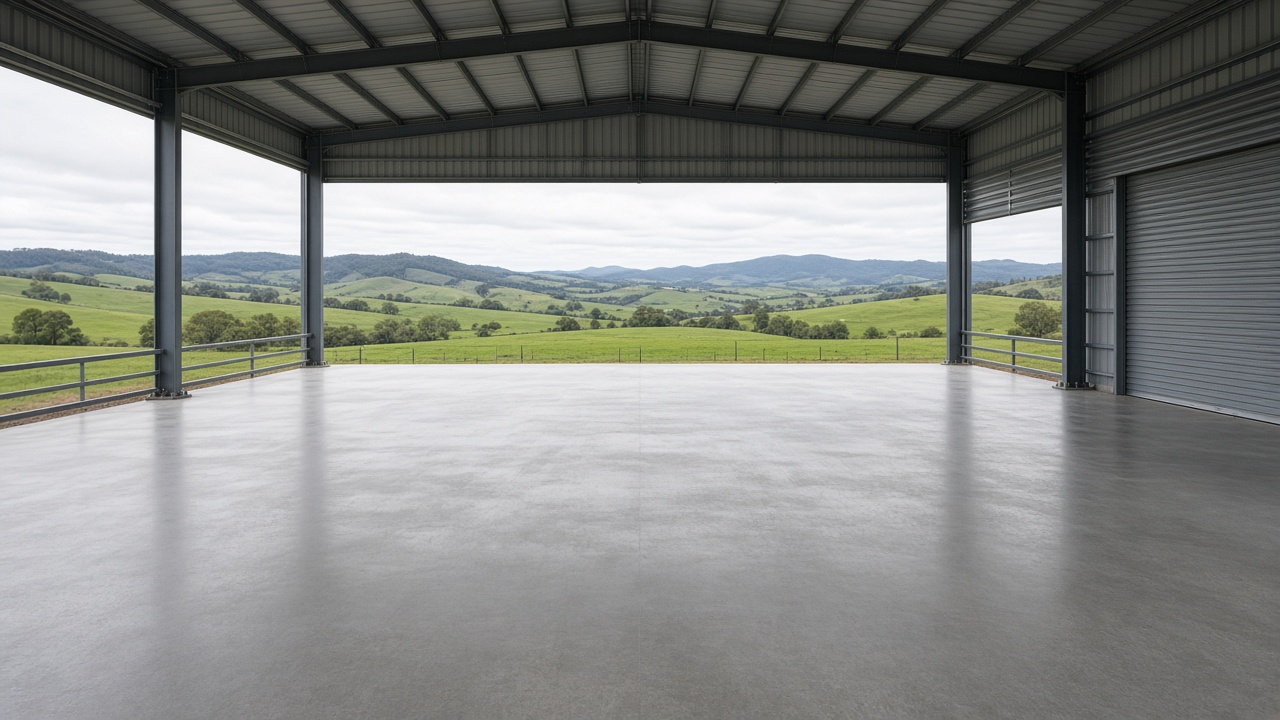
Farm and rural concreting around Trafalgar
Concrete for dairy farms, beef and horse properties, potato growers and lifestyle acreage around Trafalgar: yards, feed pads, laneway crossings, gateways, trough pads, wash bays, farm entrances and shed aprons built for stock, machinery and Gippsland mud.
Email: info@trafalgarconcreting.com.au
Built for working properties
Trafalgar is surrounded by some of Victoria's most productive farming country. Dairy herds graze the green valley and hills, beef cattle and horses run on smaller holdings, and the red soils toward Thorpdale grow potatoes. All of that work creates mud, wear and heavy loads, and concrete placed in the right spots saves time, protects stock and keeps machinery moving through the wettest months.
Dairy concrete
Dairies need concrete that copes with hundreds of hooves twice a day, constant water and effluent. We pour holding yards, feed pads, exit races, laneway sections and wash-down areas with: – grooved or heavy broom finishes so cattle do not slip – falls toward effluent channels, sumps or drains – thickness and steel suited to stock and tractors – joints set out to suit scraping and cleaning
Drainage and effluent management are central to any dairy job, and we plan where water goes before setting levels.
Gateways and laneway crossings
A gateway that turns into a bog every winter wears out stock, staff and gates. A concrete gateway pad, sized for the herd and the machinery that passes, ends the pugging. Laneway crossings at creeks, drains or busy junctions benefit from concrete with culverts where water needs to pass.
Trough pads and feed areas
Troughs churn the ground around them into mud. A concrete trough pad keeps it firm, keeps the trough level and makes cleaning easier. Feed pads and hay feeding areas stop feed being trampled into the ground and protect pasture.
Horse properties
Stable floors, wash bays, tack room slabs, float parking and yards around stables are common jobs on horse properties around Trafalgar and Yarragon. We use non-slip finishes where horses walk and falls to drains in wash bays.
Potato and cropping farms
Potato growers need hardstands for trucks and bins, washing and grading areas, fuel bay slabs and shed floors that carry loaded vehicles. We pour these with thickness and steel to suit, aprons to keep red soil out of sheds, and drainage around wash areas.
Farm entrances and tracks
The entrance off the road takes the heaviest traffic on any farm, from milk tankers to feed trucks. A concrete entrance with a culvert and headwalls stops it breaking up. Steep sections of farm tracks can be concreted to stop erosion. Road entrances need road authority consent, which we help with.
Shed aprons and floors
Machinery, hay and workshop sheds need aprons at the openings to keep mud out, and floors suited to the use. See our shed slab page for more detail.
Access and timing
Rural jobs often involve long distances from the road, soft paddocks and seasonal constraints. We plan truck and pump access, and where possible schedule work in drier months. If a job cannot wait, temporary tracks can help.
Written quotes
We visit the property, walk the areas with you, and send a written, itemised quote for each part of the job, so you can stage work if you prefer.
Calf sheds, bales and storage areas
Calf rearing sheds need floors that drain well and can be cleaned thoroughly between batches, with falls to a channel and a finish that is textured enough to stop calves slipping without being too abrasive. Hay and silage storage areas benefit from a concrete floor or pad that keeps bales off wet ground and stops machinery pugging the area during feed-out. Fertiliser and chemical storage may need bunded slabs to contain spills. We discuss each of these with you on the visit.
Effluent and wash water
On dairies and other intensive areas, concrete must direct effluent and wash water to the right place: an effluent pond, a sump, a separator or a sediment trap. Getting falls and channels right is critical, because effluent sitting on concrete or running into the wrong drain creates problems for animal health and the environment. We set levels carefully and work with your existing system or an effluent designer's plan.
Stock-friendly finishes
Cattle and horses need grip. Smooth concrete becomes dangerously slippery when wet or covered in manure, while very rough finishes can damage hooves. Grooved patterns, heavy broom finishes or textured rollers give a balance between grip and wear. In laneways and yards, the groove direction is set across the main direction of travel.
Working around the farm calendar
We know farm work does not stop for concreting. We plan jobs around calving, milking times, hay season and wet months where possible, and stage work so yards and gateways stay usable. Concrete in stock areas needs time to cure before animals walk on it, and we give clear advice on when the area can be used again.
Rural water and tanks
Water tanks need a level, firm base. Concrete tank pads, sized and reinforced for the full weight of a filled tank, prevent tanks from tilting or cracking. We also pour pads for pumps, pressure systems and fuel tanks.
Bridges, fords and culvert headwalls
Where farm tracks cross creeks and gullies, concrete fords, culvert headwalls and simple crossings keep the track usable in wet weather and reduce erosion. These works may need approval from the catchment authority, which we can help you identify.
Concrete around machinery and fuel
Fuel storage, chemical mixing areas and machinery wash pads benefit from concrete slabs with bunds or falls to a collection point, so spills can be contained and cleaned up. These slabs protect soil and waterways and make the work area cleaner and safer. We size them for the tanks and machines you use.
Gippsland clay, river flats, red hill soil and two councils
Around Trafalgar the ground changes with the landscape. Town blocks and most new estates sit on yellow and grey clay that swells with winter rain and shrinks in a dry summer. The river flats hold softer silt that stays wet for weeks. South toward Trafalgar South and Thorpdale, the Strzelecki foothills bring deep red volcanic soil that drains freely but goes soft when saturated and scours on a slope. On clay we remove topsoil and soft material and build up compacted crushed rock in layers; on wet flats we may go deeper and lift the finished level; on hill soils we focus on edge support and stopping runoff before it undercuts the slab.
Work inside your boundary is usually permit-free. Crossovers, nature strips and public footpaths are road reserve, which needs consent from Baw Baw Shire for Trafalgar, Yarragon, Warragul, Drouin, Darnum, Thorpdale and Narracan, or Latrobe City for Moe, Newborough and Morwell. Rural entrances on main roads may also involve the state road authority, and slabs for houses, garages and large sheds need a building permit and engineering. We list whatever applies in the quote.
How a Trafalgar Concreting quote is put together
Every quote we send is in writing and itemised, so you can see where the effort goes. It sets out the measured area, any break-out of old concrete and disposal, the excavation depth, the crushed rock under the slab and how it will be compacted, the slab thickness and reinforcement, the finish and colour or stone blend, where the joints will run, drains and pits and where water ends up, any steps, edges or retaining, sealing, and any crossover, road authority or building permit work. Anything that changes the job on the day, such as pump hire for a back yard, a long barrow run or a paddock that needs a temporary track, is spelled out rather than left as a surprise.
We do not advertise a square-metre rate. A driveway on firm clay in a Trafalgar estate, the same driveway on soft Moe River silt, and one climbing a red-soil hill toward Thorpdale each need different preparation, and that is where much of the work sits. Seeing the block first means the quote reflects your job, not an average.
Working with Trafalgar Concreting
Based in Trafalgar 3824
Our base is in town, between Warragul and Moe, so West Gippsland and Latrobe Valley jobs are close by.
Clay, flats and hill soils
We test the ground on every job and prepare the base to suit it, instead of using one depth everywhere.
Free itemised quotes
No published rates, no charge for the visit, and every line of the job written down.
Homes, farms and industry
Estate driveways, house slabs, dairy yards, sheds and industrial floors, with permits identified upfront.
How a job runs, step by step
- 1
Get in touch
Call, email or use the form. Photos of the area, the frontage and any tricky access help us prepare.
- 2
Site visit
We measure up, take levels, check the soil, look at where water goes and show finish samples on site.
- 3
Written quote
An itemised quote covering preparation, base, thickness, steel, finish, joints, drainage and any permits.
- 4
Ground work
Old concrete and soft soil are removed, crushed rock is compacted, forms are set and steel is placed on chairs.
- 5
The pour
Concrete arrives by truck or pump, is screeded and finished, and is protected from rain, wind or heat while it cures.
- 6
Hand-over
Joints are cut, forms removed, the site cleaned up, sealer applied if included, and care notes left with you.
Farm and Rural Concrete questions
Do you pour dairy yards and feed pads?
Yes, with non-slip finishes, falls to effluent or drainage points and strength suited to stock and machinery.
Can you fix a muddy gateway?
Yes. A concrete gateway pad stops pugging and keeps gates working through winter.
Can a concrete truck reach my paddock?
We check access on the visit and plan tracks or a pump if needed.
Where we work
Other concreting services
Speak with a Trafalgar concreter
We visit, measure and test the ground at no cost, then send a written quote for jobs in Trafalgar 3824, Baw Baw Shire and the western Latrobe Valley. There are no prices on this site because no two blocks are alike.